Crater glaze – 1280°C, cone 9 oxidation (Aki Moriuchi)
Nepheline syenite 60
Barium carbonate 18
China clay(koalien) 11
Flint 13 (kwarts)
+
Silicon carbide 4
 |
| Moss jug, Carys Davies, 2010. Copper carbonate slip under crater glaze on porcelain, height 5cm. The copper turns red where reduced by the silicon carbide in the glaze. Photo: Carys Davies |
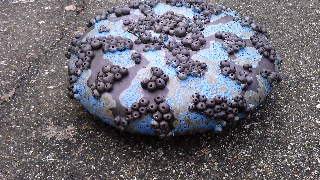
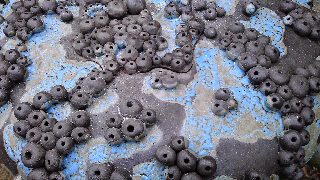
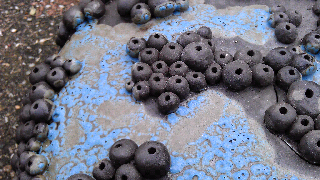
If silicon carbide is added to a viscous matt glaze, craters form when carbon dioxide is given off during firing. Silicon carbide also causes local reduction in the glaze, causing copper to turn red owing to the lack of oxygen available.
Crater glazes (cone 4-6)
The ones used successfully contain cryolite. They are fired to mid-range cones
(4-6), and require experimentation while firing, for the desired results.
These two recipes are from the CM Handbook (1977), “Ceramic Glazemaking,” by
Richard Behrens, and are amongst many crater glazes (some with extinct or
hard-to-find ingredients) found on pages 43 and 44:
Behrens Crater Glaze 5 (Cone 4-6)
Fluorospar–19%
Cryolite–34.3%
Kaolin (EPK is best)–9.0%
Flint–37.7%
Behrens Crater Glaze 10 (Cone 4-6)
Fluorospar—14.6%
Cryolite–26.3%
Kaolin (EPK)–21.0%
Flint–38.1%





 SKeramiek